
AI in Project Management
AI in Project Management is transforming how projects are planned, managed, and delivered. AI tools help project managers automate routine tasks, analyze project data, manage resources, identify risks, and make faster decisions. From project planning and scheduling to monitoring and reporting, AI can improve team productivity and project performance. This guide explains the benefits, applications, challenges, and future of AI in project management.
Table of Contents
Getting Started with AI in Project Management
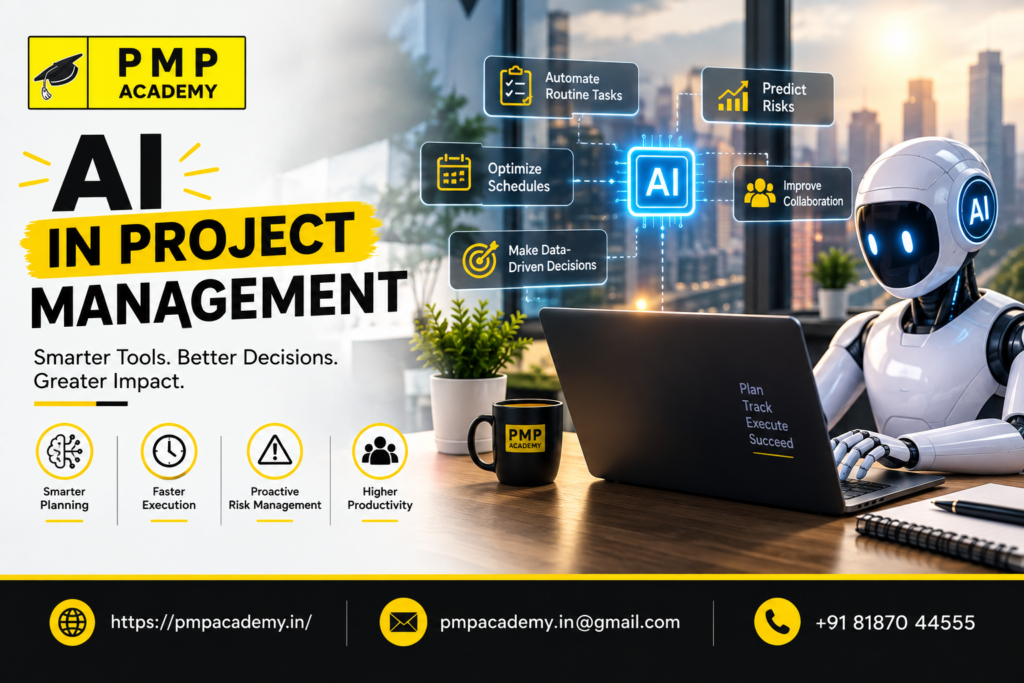
Project management is undergoing a revolution—driven by Artificial Intelligence (AI)—that’s transforming how projects are planned, executed, and delivered across the globe, including in India’s rapidly expanding tech and business sectors. But what exactly is AI, and why is it essential for today’s and tomorrow’s PMP professionals?
What Is Artificial Intelligence (AI)?
- Artificial Intelligence (AI) refers to the simulation of human intelligence processes by machines, especially computer systems. If you’d like a broader, freely accessible primer before going further, Wikipedia’s entry on artificial intelligence is a solid starting point.
- This includes learning (acquiring information and rules for using it), reasoning (using rules to reach approximate or definite conclusions), and self-correction.
- In project management, AI’s capabilities—like machine learning, natural language processing (NLP), automation, and predictive analytics—are harnessed to streamline workflows, enhance decision-making, and optimize resource allocation.
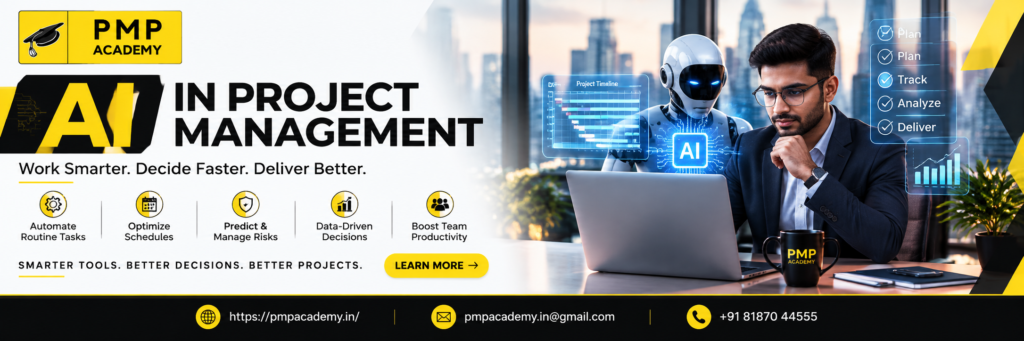
How AI Is Transforming Project Management in 2026
As of 2025, AI is no longer a futuristic concept; it’s a competitive necessity in project management, particularly in dynamic markets such as India and the Asia-Pacific region. AI-powered project management tools can:
- Automate repetitive tasks: Scheduling, reporting, and task assignments now require less manual input, enabling PMs to focus on strategy.
- Provide real-time insights: AI analyzes massive datasets to flag risks, forecast resource needs, and recommend adjustments instantaneously.
- Enhance collaboration: AI-driven chatbots and virtual assistants bridge communication gaps, especially in distributed and hybrid teams—common in India’s growing IT sector.
- Predict project outcomes: Machine learning identifies potential bottlenecks and success factors far ahead of time, empowering proactive management.
The world’s leading companies and local Indian startups alike are leveraging AI-driven project management platforms to boost productivity, reduce costs, and deliver value faster than ever before.
Importance of Adapting to AI-Driven Solutions for PMP Professionals
- For PMP (Project Management Professional) aspirants and certified managers, embracing AI is vital for career resilience and organizational competitiveness. Learn more about PMP Academy and how we prepare professionals for this shift.
- The Project Management Institute and top training institutes in India highlight AI and digital transformation as top strategic priorities for today’s project leaders. If you want the certifying body’s own take on what the discipline covers, PMI’s explainer on what project management involves is worth a read.
Now let’s unpack what actually happens inside each module.
Benefits of AI in Project Management
Artificial Intelligence (AI) is rapidly reshaping how projects are conducted, delivering significant advantages that are revolutionizing efficiency and outcomes in project management, especially in fast-growing markets such as India.
- One of the most notable benefits of AI in project management is the marked improvement in efficiency and productivity. AI tools automate routine and time-consuming tasks like scheduling, progress tracking, and report generation.
- This automation frees project managers and teams to focus on strategic decision-making and creative problem-solving.
- By reducing manual input and human error, teams complete their work faster and with higher accuracy, which directly enhances overall productivity.
- Further strengthening project workflows, AI provides real-time insights that enable better planning and resource allocation. AI systems can process large volumes of project data to identify trends, forecast resource needs, and flag potential risks long before they escalate.
- This proactive approach helps in optimizing budgets, improving timelines, and ensuring resources are deployed exactly where they’re needed.
- Decision-makers benefit from data-driven recommendations, gaining clarity and confidence during project execution.
- In addition, AI fosters enhanced team collaboration and communication, which are critical for projects spread across multiple locations or involving hybrid teams.
- AI-powered chatbots, virtual assistants, and intelligent collaboration platforms streamline communication channels by providing instant responses, scheduling meetings, and offering contextual suggestions that keep everyone aligned.
- These features are especially valuable in the dynamic and diverse Indian business environment, where teams may work across time zones and cultures.
- A direct result of these advancements is a reduction in project failure rates. With AI-driven risk identification, continuous monitoring, and predictive analytics, project managers can mitigate issues before they develop into serious problems.
- This leads to higher project success rates, improved stakeholder satisfaction, and better alignment with business goals.
- For PMP professionals aiming to stay competitive, learning to leverage AI’s capabilities is increasingly crucial. If you’re building complementary skills, explore our Business Analyst coaching in Hyderabad to strengthen your data and requirements-analysis toolkit alongside AI adoption.
- Overall, integrating AI in project management transforms how teams operate by increasing speed, precision, and collaboration, making it an indispensable tool for modern project professionals.
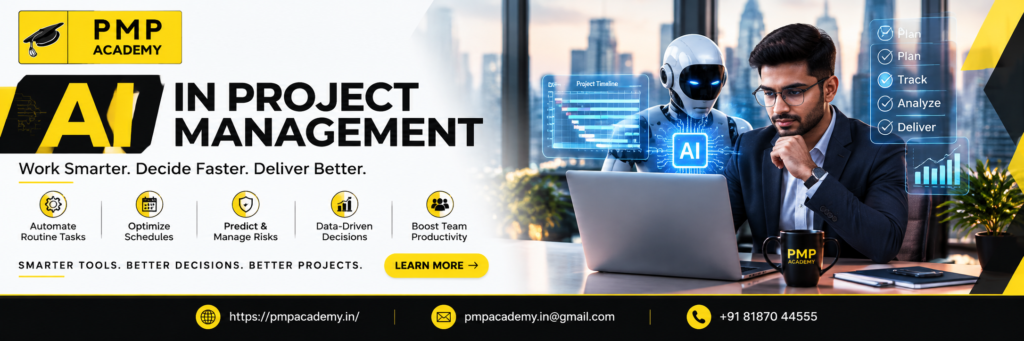
AI Technologies Used in Project Management
Advancements in artificial intelligence are fundamentally changing project management, with machine learning, natural language processing (NLP), predictive analytics, and automation driving major improvements in both global and Indian contexts.
Machine Learning
- Machine learning enables project management tools to learn from historical project data and uncover patterns that support better planning, forecasting, and resource optimization. If you want a clear, freely readable breakdown of how this actually works under the hood, IBM’s overview of machine learning is a good non-technical reference.
- These systems help predict project timelines, flag potential risks, and recommend efficient resource allocations. Organizations benefit by identifying bottlenecks or inefficiencies well in advance, allowing for proactive action and minimizing costly overruns.
Natural Language Processing (NLP)
- NLP empowers tools to understand and analyze vast amounts of project communications such as emails, chats, or reports. By extracting actionable insights from text, NLP can identify issues, flag risks, and even automate routine reporting.
- This not only ensures important information isn’t overlooked but also fosters clearer, faster team communication, especially valuable in large and distributed projects common in India’s tech sector. For a deeper but still accessible explanation of the underlying technology, IBM’s guide to natural language processing covers the basics well.
Predictive Analytics
- Predictive analytics uses data mining and models to forecast project outcomes, resource demand, and potential risks. These insights let project managers anticipate challenges before they arise, adjust plans accordingly, and ensure smoother delivery.
- Predictive analytics is increasingly adopted in sectors like IT, construction, and consulting in India for better control over timelines and budgets. If you’re unfamiliar with the term itself, Investopedia’s definition of predictive analytics lays out the core concept in plain language.
Automation
- Automation reduces manual administrative workload by handling repetitive tasks like scheduling, reporting, meeting reminders, and progress tracking. IBM’s overview of automation is a useful, freely accessible reference if you want to understand the broader concept beyond project management specifically.
- AI-driven automation ensures accuracy, saves time, and lets teams focus on high-value activities such as strategy and innovation.
- AI chatbots and virtual assistants, for instance, are making project communication seamless and enabling round-the-clock support for teams working across time zones. Since much of this automation is built around Agile workflows, professionals may also benefit from our Scrum Master training in Hyderabad to apply these tools within sprint-based delivery.
Trends in AI Adoption Across India and Globally
- India is witnessing a surge in AI adoption, with both startups and established enterprises integrating AI-driven project management solutions to stay competitive.
- Analysts at Gartner predict that by 2030, up to 80% of project management tasks will be AI-powered. Global trends mirror this shift, emphasizing dynamic scheduling, adaptive resource planning, and AI-driven risk management.
- Self-learning project management systems and advanced NLP tools are becoming mainstream, supporting smarter, faster decision-making and keeping Indian professionals aligned with international best practices.
Tools and Software for Project Management: AI-Driven Solutions
The project management landscape in 2025 has been reshaped by the proliferation of AI-powered project management tools, offering smarter, faster, and more collaborative ways to manage projects, especially for professionals and organizations in India aiming for global standards.
- Jira: Renowned for software and IT project management, Jira has integrated AI for intelligent task assignment, predictive analytics on project timelines, and automated sprint planning. Its AI features support advanced bug tracking, real-time risk analysis, and comprehensive reporting, making it favored among tech enterprises.
- Microsoft Project (with AI): Microsoft Project now incorporates generative AI to automate scheduling, suggest optimal resource allocations, and generate instant reports. Its powerful integrations with Teams and Power BI elevate real-time collaboration and visualization, supporting complex project portfolios for enterprises of any size.
- Asana: Asana’s AI system can draft project briefs, set automated reminders, analyze workflows for optimization, and even summarize lengthy discussions into actionable next steps. Its user-friendly interface and automation features are widely adopted by global and Indian startups for streamlined project delivery.
- Trello: Trello offers AI-based task suggestions, card automation, and smart deadline management. The platform’s “Butler” automation tool uses AI to optimize task workflows and recommends process improvements, making it ideal for agile and remote teams.
- Wrike: Wrike stands out with its AI-powered resource forecasting, scenario planning for risk management, and automated report generation. Teams can leverage its real-time dashboards and embedded financial tracking features for holistic project insights.
- Epicflow: Tailored for multi-project environments, Epicflow uses AI for scenario analysis, constraint management, and predictive risk identification—empowering project leaders to make proactive decisions.
- Teamwork.com: The tool’s AI assistant generates task lists from project descriptions, summarizes long comment threads, and automates expense logging, helping busy teams keep projects on track with minimal manual effort.
- Wrench SmartProject (India): Specifically prominent in Indian markets, Wrench offers real-time AI-powered collaboration and insights tailored for construction, infrastructure, and large-scale projects.
Notable Indian Project Management Tools with AI Features
- Celoxis: A leading India-based project management solution, Celoxis provides AI-driven insights, centralized dashboards, and predictive project health scoring to streamline resource allocation and decision-making.
- Wrench SmartProject: Widely used in India, this tool excels in construction and infrastructure sectors, providing AI-driven collaboration, real-time data visibility, and prediction models for project risks and timelines.
How AI Tools Are Impacting Project Management in India
- Indian organizations increasingly adopt AI-powered solutions for complex projects, leveraging local platforms (like Celoxis and Wrench) alongside global leaders (such as Jira and Microsoft Project) to maximize efficiency, reduce costs, and gain data-driven project control.
- These tools provide actionable insights, minimize manual errors, and ensure teams remain competitive on a global scale. If you want a deeper dive into what’s coming next, check out our follow-up post on Project Management Tools 2026.
Impact of AI on Decision Making in Projects
Artificial Intelligence (AI) is redefining project management, especially decision-making, by turning vast streams of project data into actionable insights, minimizing human error, and supporting more successful outcomes.
Real-World Examples of AI-Driven Decision-Making
- Construction Projects: IBM Watson’s AI has been used to manage complex infrastructure projects, integrating vast logistics and multi-stakeholder coordination. The results have included fewer delays and lower costs, as predictive algorithms highlighted potential risks and recommended corrective action—long before problems materialized.
- Healthcare IT Rollouts: Major hospital networks in the US have used AI to support the deployment of electronic health record systems. AI optimized resource allocation, provided real-time risk assessments, and scheduled critical milestones, leading to faster and smoother implementations.
- Indian Enterprises: Local organizations using platforms like Wrench SmartProject leverage AI for predictive risk analysis and smart resource allocation in large-scale infrastructure and IT projects.
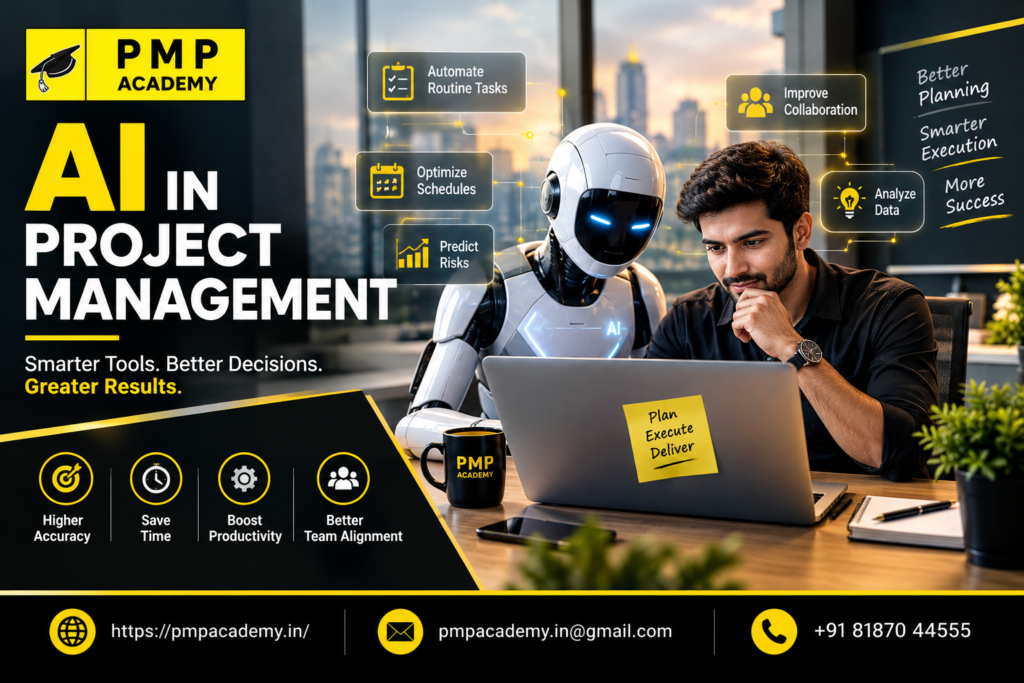
The Evolving Role of the Project Manager
While AI tools are automating an estimated 80% of traditional project management tasks by 2030, the role of the project manager is not disappearing—instead, it’s evolving. Project managers are shifting toward strategic decision-making, cross-functional leadership, and ethical AI oversight.
Future Trends: The Road Ahead for AI in Project Management
Artificial Intelligence is poised to profoundly disrupt and elevate project management worldwide and in India, signaling the dawn of a new era defined by automation, data-driven insights, and a strategic shift in job roles.
Recommendations for PMP Professionals to Stay Updated
To remain indispensable in the evolving project management landscape, PMP professionals should:
- Upskill in AI and data analysis through specialized courses and certifications.
- Embrace hybrid skills that blend technical knowledge with leadership and ethical oversight.
- Leverage AI-enabled project management platforms in everyday work.
- Participate in professional communities like PMI and explore government-backed digital skilling programs in India.
- Foster human-AI collaboration to work with, rather than be replaced by, intelligent systems.
Ready to future-proof your project management career? Explore our courses or get in touch with our team to learn how PMP Academy prepares you for the AI-driven future of project management.
Frequently Asked Questions
1. What is AI in project management and its key functions?
AI uses technologies like machine learning and automation to streamline tasks and enhance decisions.
2. What benefits does AI bring to project management?
AI improves efficiency, predicts risks, optimizes resources, and strengthens team collaboration.
3. Will AI replace project managers?
No, AI assists by automating routine tasks but human leadership remains crucial.
4. How does AI identify and manage project risks?
It analyzes data to predict risks early and suggests mitigation strategies.
5. What are the top AI project management tools in 2025?
Leading tools include Jira, Asana, Microsoft Project (with AI), Celoxis, and Wrench SmartProject.
6. How does AI enhance team collaboration?
AI-powered virtual assistants and chatbots streamline communication and task coordination.
7. Can AI optimize project scheduling and resource allocation?
Yes, AI analyzes workloads and skills to suggest optimal scheduling and resource use.
8. What challenges exist in adopting AI for projects?
Data quality, bias, privacy concerns, and need for human oversight are key issues.
9. How secure is data in AI project management tools?
Top tools use encryption and comply with regulations, but vigilance is essential.
10. Do AI tools integrate with other workplace applications?
Yes, most integrate with Slack, Teams, Zoom, Google Workspace, and more.
11. How will AI affect project management careers?
AI shifts managers toward strategy, increasing demand for AI and data skills.
12. How does predictive analytics improve decisions?
It forecasts outcomes and identifies risks for proactive planning.

PMP Trainer Mr. Raju
PMP Expert | Corporate Trainer & Project Management Mentor
Mr. Raju is a Senior PMP Trainer at PMP Academy, with over 10+ years of real-world project management experience. He has mentored thousands of working professionals, helping them master corporate lifecycle frameworks and successfully clear the challenging PMI PMP certification exam.