
Is PMP Certification Worth It
PMP certification is one of the world’s most recognized project management credentials. This guide explores whether PMP certification is worth it in 2026, covering PMP certification benefits, salary growth, career opportunities, exam preparation, training options, eligibility requirements, and how PMP can help professionals build a successful project management career.
Table of Contents
Introduction
- If you have been searching for ways to grow your career in project management, you have probably come across PMP certification. It is one of the most popular and respected certifications for project managers worldwide. However, before spending time, money, and effort on it, most people ask one important question:
Is PMP certification worth it?
- This is a fair question. PMP certification is not free, and preparing for the exam takes dedication. You may need to spend weeks or even months studying. Naturally, you want to know whether the benefits are worth the investment.
- The good news is that PMP certification has helped thousands of professionals improve their careers. Many people have used it to get promotions, move into leadership roles, switch companies, and even find international job opportunities. Employers across different industries recognize PMP as proof that a professional understands project management and can handle projects effectively.
- At the same time, PMP is not a magic solution. Simply passing the exam does not guarantee a new job or a higher salary. Your experience, skills, communication ability, and performance still matter. PMP works best when combined with real project experience.
- In this guide, we will look at the real value of PMP certification in 2026. We will discuss who should get it, who should wait, the benefits, salary impact, and whether it still makes sense in today’s rapidly changing job market.
By the end of this article, you will have a clear answer to whether PMP certification is worth it for your career.
What Does PMP Certification Mean?
- PMP stands for Project Management Professional. It is a certification that shows a person has the knowledge and skills needed to manage projects successfully.
- Every company runs projects. A project can be anything from developing a software application to building a bridge, launching a marketing campaign, upgrading company systems, or introducing a new product.
- Projects involve many moving parts. Teams must work together, deadlines must be met, budgets must be controlled, and problems must be solved quickly. Project managers are responsible for making sure everything moves in the right direction.
PMP certification helps professionals learn how to manage these responsibilities effectively.
The certification covers important areas such as:
- Project planning
- Team management
- Risk management
- Budget control
- Communication
- Stakeholder management
- Quality management
- Project execution
- Agile and hybrid project approaches (see our full PMP syllabus breakdown)
Because these skills are useful in many industries, PMP certification is valuable for professionals from different backgrounds.
Whether you work in IT, construction, engineering, healthcare, finance, manufacturing, or consulting, project management skills can help you grow professionally.
Table of Contents
ToggleWho Gives the PMP Certification?
- Professionals earn the PMP certification through PMI, a globally recognized project management organization.
- PMI is a globally recognized organization focused on project management education and standards. It has been helping professionals improve their project management skills for many years.
- When employers see PMP certification on a resume, they recognize that the person has met PMI’s standards and passed a challenging exam.
- This is one of the reasons PMP is trusted by organizations around the world.
- Unlike some certifications that are only popular in certain countries, PMP has international acceptance. This gives professionals confidence that their certification will be recognized wherever they work.
Why Is PMP Known Around the World?
One major reason PMP is respected globally is its consistency.
The certification teaches project management principles that can be applied in many industries and countries. Whether a company is located in India, the United States, Australia, Germany, Canada, or Singapore, many project management challenges are similar.
Projects still need:
- Planning
- Scheduling
- Budget management
- Team coordination
- Risk management
- Leadership
PMP provides knowledge and techniques that can help professionals deal with project-related issues more effectively.
- Another reason for its popularity is the growing demand for project managers worldwide. As organizations become larger and projects become more complex, businesses need skilled professionals who can lead teams and deliver results.
This demand has helped PMP maintain its reputation as one of the leading certifications in project management.

Is PMP Certification Worth It?
For many professionals, the answer is yes.
PMP certification can be worth the investment if you want to build a long-term career in project management or leadership.
However, it is important to understand what PMP can and cannot do.(See PMI’s own guidance on deciding if the PMP is right for you.)
What PMP Can Do
PMP can:
- Strengthen your resume
- Improve your project management knowledge
- Increase your credibility
- Help you qualify for more job opportunities
- Support career growth
- Improve confidence during interviews
- Increase your professional network
What PMP Cannot Do
PMP cannot:
- Guarantee a job
- Automatically increase your salary
- Replace experience
- Make you a great manager overnight
Some people expect immediate results after getting certified. When those expectations are unrealistic, they may feel disappointed.
The reality is that PMP is a professional tool. Like any tool, its value depends on how you use it.
Professionals who combine PMP certification with strong work experience often see the best results.
For example, imagine two professionals with similar project experience.
One has no certification.
The other has PMP certification.
When applying for a project management role, the PMP-certified candidate may have an advantage because the certification demonstrates commitment to learning and professional growth.
For this reason, employers frequently see PMP-certified professionals as strong candidates for project-related roles.
Who Should Get PMP Certification?
Not everyone needs PMP certification.
However, certain professionals can benefit greatly from it.
Working Professionals
- Many professionals reach a point where they want more responsibility and better career opportunities.
- They may already be managing projects informally but do not have an official project manager title.
- PMP certification helps these professionals validate their skills and demonstrate their readiness for larger responsibilities.
- For someone with several years of work experience, PMP can become a valuable addition to their professional profile.
IT Professionals
Technology projects have become more complicated than ever before.
Companies regularly work on:
- Software development
- Cloud migration
- Cybersecurity improvements
- Digital transformation
- Data analytics projects
These projects involve multiple teams and stakeholders.
Technical knowledge alone is often not enough.
- Organizations need professionals who can coordinate people, manage schedules, solve problems, and ensure successful project delivery.
- Enrolling in a PMP certification helps IT professionals develop these management skills.
- This is why many software engineers, technical leads, system administrators, and IT managers pursue PMP certification ,Many also pair it with a Business Analyst skill set for broader career flexibility.
Engineers
- Engineers are often responsible for much more than technical work.
- They may need to coordinate resources, communicate with clients, monitor project progress, and manage deadlines.
- As engineers move into senior positions, project management becomes increasingly important.
- PMP certification helps engineers develop leadership and project coordination skills that support career growth.
- Many engineers use PMP as a stepping stone toward management positions.
Team Leaders
- Team leaders already manage people and tasks.
- However, managing projects requires additional skills.
- PMP teaches structured approaches for planning, monitoring, and controlling project activities.
- This knowledge can help team leaders become more effective managers.Some also explore the Scrum Master role as a complementary path.
Project Coordinators
- Project coordinators often work closely with project managers and support project activities.
- For many coordinators, PMP certification becomes the next logical step in their career development.
- It gives them the knowledge and confidence needed to take on project manager roles.
People Planning a Project Manager Career
- If your goal is to become a project manager, PMP is one of the most recognized certifications available.
- It can help demonstrate your commitment to the profession and strengthen your qualifications when applying for project management roles.
Who Should Wait Before Getting PMP?
Although PMP offers many advantages, it is not the right choice for everyone immediately.
Sometimes waiting can be the smarter decision.
If You Don't Meet the Eligibility Requirements
PMP has eligibility requirements related to education and project management experience.
If you do not yet qualify, focus on gaining practical experience first.
The experience you gain now will make the certification more valuable later.
If You Only Want a Certificate Without Project Experience
Many beginners believe certifications alone can guarantee career success.
Unfortunately, employers usually look for both experience and certification.
A certificate may help open doors, but real experience helps you succeed once those doors open.
If you have little or no project experience, gaining practical exposure should be a priority.
If You Are Not Ready to Prepare Seriously
The PMP exam is respected partly because it is challenging.
Candidates must understand concepts and apply them to real-world situations.
Preparation requires discipline and commitment.
If you are not ready to invest the necessary study time, waiting until you can focus properly may be the better choice.
Top Benefits of PMP Certification
One of the main reasons professionals decide to pursue PMP certification is the wide range of career benefits it can provide. While every person’s experience is different, many PMP-certified professionals report positive changes in their careers after earning the certification.
Let’s look at some of the most important PMP certification benefits.
Better Job Opportunities
- The job market has become increasingly competitive. For a single project management position, companies may receive applications from dozens or even hundreds of candidates.
- When recruiters review resumes, they look for factors that help identify strong candidates. PMP certification is often one of those factors.
- Many companies specifically mention PMP certification in job descriptions. Some organizations list it as a preferred qualification, while others make it a requirement for certain project management roles.
- Having PMP certification can help your resume get noticed and may increase your chances of being shortlisted for interviews.
- It also shows employers that you are serious about project management as a profession and willing to invest in your own professional development.
Higher Salary
- Salary growth is another major reason professionals pursue PMP certification.
- Companies understand that effective project management can directly affect business results. Projects that finish on time and within budget help organizations save money and achieve their goals.
- Because of this, organizations often place higher value on professionals who have proven project management skills.
- Although salary increases are never guaranteed, PMP certification can strengthen your position when discussing compensation with employers.
- Many professionals view PMP as an investment that can provide long-term financial benefits throughout their careers.
Global Recognition
- Not every certification has worldwide acceptance.
- One of PMP’s biggest advantages is that it is recognized in many countries and industries.
- Whether you work in India or plan to explore opportunities abroad, PMP can help demonstrate your knowledge and professional commitment.
- This global recognition can be especially useful for professionals interested in working with multinational companies or international clients.
Better Leadership Skills
Managing a project involves much more than tracking timelines and controlling costs.
A large part of the role involves working with people.
Project managers often need to:
- Lead teams
- Resolve conflicts
- Motivate team members
- Communicate with stakeholders
- Make important decisions
PMP certification helps professionals develop these leadership skills.
The knowledge gained during preparation can make you a more effective leader, even if your current role is not officially called “Project Manager.”
More Confidence During Interviews
- Many candidates feel nervous when interviewing for project management positions.
- Employers often ask questions about planning, risk management, stakeholder communication, and leadership.
- The preparation process helps candidates build a solid understanding of key project management topics.
- As a result, many professionals feel more confident discussing project management topics during interviews.
- Confidence alone may not get you the job, but it can help you present your experience more effectively.
Career Growth
Perhaps the biggest benefit of PMP certification is long-term career growth.
Many professionals use PMP as a stepping stone toward positions such as:
- Project Manager
- Senior Project Manager
- Program Manager
- Delivery Manager
- PMO Manager
- Portfolio Manager
The certification can support career progression and help professionals move into positions with greater responsibility.
Does PMP Certification Increase Salary?
One of the most common questions people ask is:
Does PMP certification increase salary?
The honest answer is that PMP certification can contribute to higher earning potential, per PMI’s own salary survey data, but it is not the only factor that affects salary.
Employers consider many factors when deciding compensation, including:
- Experience
- Industry
- Skills
- Location
- Leadership ability
- Company size
- Job responsibilities
However, PMP certification often strengthens your overall profile and can help support salary growth.
PMP Salary in India
Project management professionals are in demand across many industries in India.
Organizations continue to invest in technology, infrastructure, digital transformation, manufacturing, and business improvement projects.
As projects become larger and more complex, companies need professionals who can manage them effectively.
PMP-certified professionals often find opportunities in:
- Information Technology
- Construction
- Engineering
- Manufacturing
- Banking
- Healthcare
- Telecommunications
- Consulting
While salary levels vary widely, PMP certification can help professionals position themselves for higher-paying roles and leadership opportunities.
Many employers view PMP as evidence that a candidate has both practical experience and formal project management knowledge.
Global Salary Opportunities
PMP’s worldwide recognition can also support international career growth.
Professionals who want to work abroad often find that PMP is understood and respected by employers in many countries.
This can make it easier to apply for project management positions outside your home country.
Many multinational organizations also prefer employees who understand internationally recognized project management practices.
Why Companies Pay More
Project managers have a direct impact on business success.
When projects fail, companies may lose time, money, customers, and opportunities.
When projects succeed, organizations achieve growth, improve efficiency, and increase profitability.
As a result, employers appreciate individuals who can:
- Deliver projects successfully
- Manage budgets effectively
- Reduce project risks
- Coordinate teams efficiently
- Communicate clearly with stakeholders
These skills create business value, which is one reason employers may offer higher compensation to strong project managers.
Is PMP Still Worth It in 2026?
The workplace is changing rapidly.
- Artificial intelligence, automation, Agile methodologies, and digital transformation are influencing how organizations operate.
- Because of these changes, some professionals wonder whether PMP certification is still relevant.
The answer is yes.
- In fact, project management skills may be even more valuable today than they were in the past.a trend we cover in detail in our piece on sustainability in project management.
What About AI?
AI tools can help automate certain tasks.For a deeper look at how this is playing out, see our guide on AI in project management and PMI’s breakdown of the AI skills project managers need.
For example, AI can assist with:
- Reporting
- Data analysis
- Documentation
- Scheduling suggestions
- Risk identification
However, AI cannot fully replace human leadership.
Projects still require professionals who can:
- Make decisions
- Manage stakeholders
- Resolve conflicts
- Build trust
- Motivate teams
- Handle unexpected situations
These responsibilities require human judgment and communication skills.
What About Agile?
- Some people assume Agile has replaced traditional project management.
This is not true.
- Many organizations now use Agile, Hybrid, or Predictive approaches depending on their needs.
- PMP has evolved to include Agile and Hybrid concepts, making it highly relevant in modern project environments, a shift backed by PMI’s own research on hybrid and fit-for-purpose approaches.If you’re weighing Agile career paths, our guide to the Scrum Master role in Agile is a useful next read.
The Growing Need for Project Leaders
Organizations continue to launch new projects every year.
- Businesses need professionals who can bring structure, coordination, and leadership to these efforts.
- As long as companies run projects, skilled project managers will remain valuable.
- That is why PMP continues to be one of the most respected certifications in project management.
Common Reasons Why People Think PMP Is Not Worth It
While PMP offers many benefits, some professionals have concerns.
Let’s look at the most common reasons people hesitate.
The Exam Cost
Preparing for PMP involves expenses such as:
- Training programs
- Study materials
- Exam fees
For some people, this investment may seem expensive.
However, many professionals view PMP as a long-term career investment rather than a short-term expense.
The Study Time
PMP preparation requires effort.
This is why businesses appreciate professionals who know how to:
Working professionals often need to balance preparation with job responsibilities and family commitments.
This can be challenging.
The Difficult Exam
PMP has a reputation for being challenging.
The exam tests understanding and application rather than simple memorization.
Candidates need to think like project managers and apply concepts to real situations.
Maintaining Certification
PMP certification must be maintained through ongoing professional development activities commonly tracked as PDUs (Professional Development Units).
Some professionals see this as an additional responsibility.
Others view it as an opportunity to continue learning and stay updated.
Fear of Failure
Many candidates worry about failing the exam.
This fear is completely normal.
However, proper preparation, practice questions, and a structured study plan can significantly improve your chances of success.
PMP vs Experience: Which Matters More?
This is one of the most important questions professionals ask.
If given a choice, which matters more?
Experience or PMP certification?
The honest answer is that experience usually comes first.
Real-world experience teaches lessons that cannot be fully learned from books or exams.
Experience helps professionals understand:
- Team dynamics
- Project challenges
- Stakeholder expectations
- Problem-solving techniques
- Leadership situations
However, this does not mean PMP is unimportant.
Think of PMP as something that strengthens your experience.
Experience shows employers what you have done.
PMP certification validates your understanding of project management best practices.
The strongest candidates often have both.
For example:
- Experience alone can be valuable.
- PMP certification alone can be valuable.
- Experience plus PMP certification is usually even stronger.
Rather than choosing between them, most professionals should focus on building both.
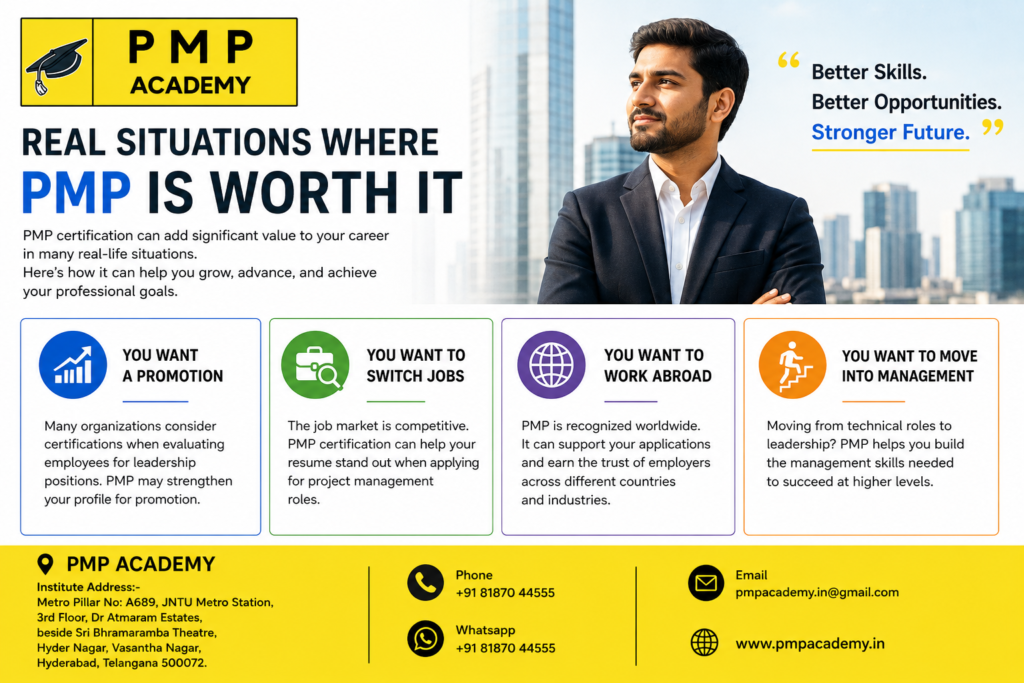
Real Situations Where PMP Is Worth It
There are certain situations where PMP can provide especially strong value.
You Want a Promotion
Many organizations consider certifications when evaluating employees for leadership positions.
If you are aiming for a promotion, PMP may strengthen your professional profile.
You Want to Switch Jobs
Changing jobs can be competitive.
PMP certification may help your resume stand out when applying for project management positions.
You Want to Work Abroad
Because PMP is recognized globally, it can support applications for international opportunities.
Many employers around the world understand and respect the credential.
You Want to Move Into Management
Professionals moving from technical roles into leadership positions often find PMP particularly useful.
The certification helps develop management skills that become increasingly important at higher levels.
Situations Where PMP May Not Be Worth It
To provide a balanced view, it is important to discuss situations where PMP may not be the right choice right now.
PMP may not be worth pursuing immediately if:
- You do not meet the eligibility requirements.
- You have little interest in project management.
- Your career goals are completely unrelated to project work.
- You expect certification alone to guarantee a job.
- You are not willing to invest time in preparation.
- You have no interest in leadership responsibilities.
In these situations, focusing on gaining experience or developing other skills may be more beneficial first.
Remember, PMP is a professional certification designed for people who genuinely want to grow in project management.
Final Verdict: Is PMP Certification Worth It?
- After considering the costs, benefits, career opportunities, and industry demand, the answer is clear:
- Yes, PMP certification is worth it for many professionals who want long-term growth in project management.
The certification can strengthen your resume, improve your credibility, help you stand out in a competitive job market, and support career advancement.
It is especially valuable for professionals who want to:
- Become project managers
- Move into leadership roles
- Increase earning potential
- Work on larger projects
- Explore international opportunities
- Build a long-term project management career
At the same time, PMP is not a shortcut to success.
- No certification can replace experience, strong communication skills, leadership ability, and consistent performance.
- The professionals who gain the most value from PMP are those who combine certification with real-world experience and a commitment to continuous learning.
- If you meet the eligibility requirements, are willing to prepare seriously, and see project management as part of your future career path, PMP certification can be one of the smartest professional investments you make in 2026 and beyond.
Frequently Asked Questions
Is PMP certification worth it in India?
Yes. PMP is widely recognized in India and can support career growth across multiple industries.
Can PMP certification guarantee a job?
No. PMP improves your profile but cannot guarantee employment.
Is PMP difficult?
The exam is challenging, but proper preparation can significantly improve your chances of passing.
Is PMP useful for engineers?
Yes. Many engineers use PMP to move into project management and leadership roles.
Does PMP increase salary?
PMP can support higher earning potential, although salary depends on multiple factors including experience and performance.
Is PMP still valuable in 2026?
Yes. Organizations continue to need professionals who can lead teams and manage projects successfully.
Can beginners take PMP?
PMP is designed for professionals with project management experience. Eligibility requirements must be met before applying.
How long does it take to prepare for the PMP exam?
Most professionals spend between 2 and 4 months preparing for the PMP exam. The exact timeline depends on your experience, study schedule, and familiarity with project management concepts.
Do employers really value PMP certification?
Yes. Many employers recognize PMP as a respected project management credential. It can strengthen your resume, improve credibility, and help you stand out when applying for project management and leadership roles.
Is PMP worth it without project manager experience?
Many professionals manage projects without having “Project Manager” in their job title. If you have experience leading tasks, teams, timelines, or deliverables, PMP can still be valuable for career growth.
Will AI reduce the value of PMP certification?
AI can automate certain project tasks, but organizations still need professionals who can lead teams, manage stakeholders, solve problems, and make decisions. These skills remain important.

PMP Trainer Mr. Raju
PMP Expert | Corporate Trainer & Project Management Mentor
Mr. Raju is a Senior PMP Trainer at PMP Academy, with over 10+ years of real-world project management experience. He has mentored thousands of working professionals, helping them master corporate lifecycle frameworks and successfully clear the challenging PMI PMP certification exam.