
PMP Certification Eligibility Criteria 2026
Master the complete PMP Certification Eligibility Criteria for 2026 with this simple, step-by-step guide.
Learn the exact PMI educational qualifications, degree requirements, and project management experience needed to qualify.Discover how to calculate your project hours properly and meet the mandatory 35 contact hours of PM training.Ideal for aspiring project managers in India and globally seeking top PMP certification training and career growth.Get clear answers on PMP exam prerequisites, application audit tips, and professional project lead requirements.Reviewed by PMP Academy experts to help you understand PMP eligibility requirements, prepare your application, and plan your certification journey.

Table of Contents
Introduction
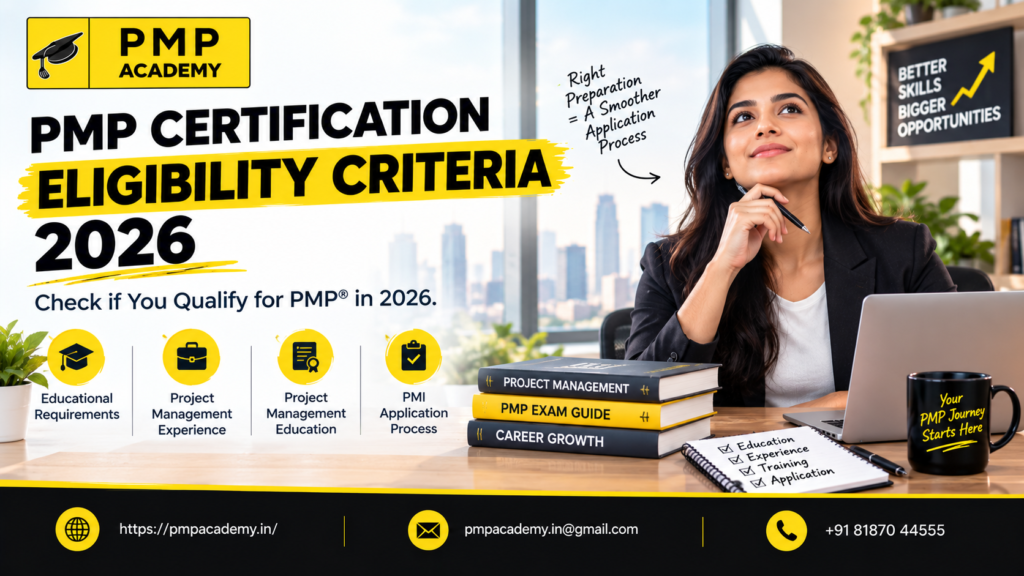
The PMP Certification eligibility criteria (2026) are defined by the Project Management Institute (PMI). To apply,Candidates must meet one of PMI’s current education and professional project experience pathways. Depending on their educational background, the requirement may be 60 months, 48 months, 36 months, or 24 months of non-overlapping project leadership experience, Your experience must include leading or directing projects across various areas, such as scope, schedule, budget, risk, and stakeholder management. PMI accepts experience from IT and non-IT industries, including Agile, Hybrid, and Predictive projects. Meeting these requirements makes you eligible to apply for the PMP certification exam, one of the most recognized project management credentials globally.Qualifying project management experience must have been gained within the 10 years before the PMP application is submitted.
PMP Eligibility Requirements 2026
- The PMP eligibility requirements 2026 are defined by the Project Management Institute (PMI) to ensure candidates have real-world project leadership experience before earning the Project Management Professional (PMP) certification. To apply, you must meet both education and experience criteria.
Bachelor’s degree or higher: Minimum 36 months (3 years) of non-overlapping experience leading projects within the past 10 years.
Associate’s-level, higher-certificate, or qualifying advanced technical/vocational qualification: Minimum 48 months (4 years) of non-overlapping experience leading projects within the past 10 years.
Secondary/high school diploma or equivalent: Minimum 60 months (5 years) of non-overlapping experience leading projects within the past 10 years.
Bachelor’s or postgraduate degree from a PMI GAC-accredited program: Minimum 24 months (2 years) of non-overlapping experience leading projects within the past 10 years.
- Your project experience must involve actively leading or directing tasks such as scope planning, schedule management, budgeting, risk control, stakeholder communication, and team coordination. PMI accepts experience across industries, including IT, construction, healthcare, finance, and manufacturing, covering Agile, Hybrid, and Predictive methodologies.
- Meeting the applicable PMP certification eligibility criteria allows you to submit your PMI application and proceed with the PMP certification process.
- PMI also requires that the qualifying project management experience be accrued within the 10 years immediately preceding the PMP application
What Counts as Project Management Experience?
- For PMP certification eligibility in 2026, the Project Management Institute requires documented experience in leading and directing projects, not just participating in them. This means your experience should show responsibility for leading projects, including planning, decision-making, delivery, coordination, and project outcomes.
- Qualifying project management experience includes defining project scope, creating schedules, managing budgets, identifying and mitigating risks, coordinating cross-functional teams, and communicating with stakeholders. You should demonstrate involvement across key process areas such as initiation, planning, execution, monitoring, and closure.
- PMI accepts experience from various industries, including IT, construction, healthcare, finance, manufacturing, and government sectors.
- PMP eligibility is not limited to one project management approach. Your professional project experience may involve predictive, agile, or hybrid ways of working, provided it meets PMI’s experience requirements. Managing software sprints, infrastructure rollouts, digital transformation programs, or operational improvement initiatives can qualify if you held a leadership or decision-making role.
- Experience should demonstrate responsibility for leading projects, including planning, decision-making, delivery, coordination, and outcomes. Simply participating in project activities without project leadership responsibility may not meet PMP eligibility requirements. Clear documentation of your project leadership responsibilities is essential for successful PMI application approval.
Common Reasons PMP Applications Get Rejected
- Applications may face issues when the information provided is incomplete, inaccurate, inconsistent, or does not adequately demonstrate the required project leadership experience. The most common reason is failing to clearly describe project leadership experience.
- PMI expects applicants to demonstrate how they led or directed projects—covering scope planning, scheduling, budgeting, risk management, stakeholder communication, and delivery outcomes—not just participated as a team member.
- Another frequent issue is overlapping project timelines, where candidates incorrectly count the same months of experience twice. Unclear or inconsistent descriptions of your project experience can make it harder to verify whether your experience meets PMI’s requirements.
- Some applications are rejected due to incorrect calculation of total experience months or failure to meet the required project management training requirement or other PMP eligibility requirements.
- During a PMI audit, the inability to provide supporting documents, supervisor verification, or training certificates can lead to disqualification. To avoid rejection in 2026, ensure your PMP application is structured, outcome-focused, and aligned with PMI’s official eligibility criteria and project management standards.
35 Contact Hours Explained – PMP Training Requirement
- To apply for the PMP, candidates need the required project management training or an active CAPM® certification. PMI currently requires 35 hours of Project Professional training unless the candidate meets the training requirement through an active CAPM® certification. To apply for the PMP, candidates need 35 hours of Project Professional training through an eligible route recognized by PMI.
- The training requirement is intended to provide project professional education before the PMP application. Candidates should choose training that meets PMI’s current eligibility requirements.
- The training must include core project management topics such as Agile, Hybrid, and Predictive (Waterfall) methodologies, risk management, stakeholder communication, scope planning, scheduling, budgeting, and leadership principles.
- PMP training can currently be completed through eligible online, on-demand, or live instructor-led courses. Starting December 1, 2026, PMI will apply additional eligibility requirements to live instructor-led training. Self-study, work experience, or informal reading of the A Guide to the Project Management Body of Knowledge (PMBOK Guide) does not qualify.Training completed before December 1, 2026 remains eligible under PMI’s current requirements.
- Completing the required training is one part of meeting the PMP application requirements. Candidates should also review the applicable education and project experience requirements before submitting their application.
Can Freshers Apply for PMP Certification?
- PMP certification requires qualifying professional project leadership experience, so candidates who do not yet have the required experience will not meet the current PMP eligibility requirements.
- The required experience depends on the candidate’s educational pathway. PMI currently lists requirements ranging from 24 months to 60 months of non-overlapping project leadership experience, with the qualifying experience earned within the previous 10 years.
- PMP is designed for professionals who have already led or directed projects involving scope planning, budgeting, scheduling, risk management, and stakeholder communication. Academic knowledge or internship exposure alone does not automatically satisfy PMI’s professional project leadership experience requirement.
- However, fresh graduates and entry-level professionals can begin their journey by gaining hands-on experience in roles like Project Coordinator, Project Analyst, or PMO Executive. They may also pursue entry-level certifications, such as CAPM, to build foundational knowledge.
- By gaining qualifying professional project leadership experience over time, entry-level professionals can work toward meeting the PMP eligibility requirements.
Documents Required for PMP Application
- When applying for the PMP certification exam, candidates must submit accurate information and maintain proper documentation as required by the Project Management Institute (PMI). While PMI does not require documents at the initial application stage, you must be prepared to provide them if your application is selected for audit.
- Candidates should keep accurate information about their education, project experience, and project professional training. If PMI selects an application for an audit, the candidate may need to provide supporting documentation to verify the information submitted.
- If audited, you may need signed verification forms from supervisors or managers confirming your project leadership roles and responsibilities. If audited, applicants may need to provide documentation showing completion of the required project management training.
- It is essential to ensure that your project descriptions match your documented experience and accurately reflect scope, schedule, budget, risk, and stakeholder management responsibilities. Keeping supporting documents organized can help make the audit verification process more straightforward if your application is selected for audit.
Why PMP Eligibility Matters for Career Growth
- Meeting the PMP eligibility criteria in 2026 is more than just a requirement to apply for the exam—it is a validation of your real-world project leadership experience.
- The Project Management Institute (PMI) sets strict eligibility standards to ensure that PMP-certified professionals have hands-on expertise in managing scope, schedule, cost, risk, stakeholders, and team performance. This eligibility requirement is intended to ensure that PMP candidates have relevant professional project leadership experience.
- Meeting PMP eligibility requirements demonstrates that a candidate has the education, project leadership experience, and training required to apply for the certification.
- Professionals who qualify for PMP are typically considered ready for leadership roles such as Project Manager, Program Manager, PMO Lead, and Delivery Manager.
- Meeting PMP eligibility requirements demonstrates professional project leadership experience rather than only theoretical knowledge. However, career outcomes such as hiring, compensation, and promotion depend on factors beyond PMP eligibility.
- In 2026, as companies prioritize Agile, Hybrid, and enterprise transformation projects, meeting PMP eligibility becomes a strong foundation for a long-term project management career advancement and global mobility.
How PMI Verifies Eligibility - PMP Audit Process
- After submitting your PMP certification application, the Project Management Institute (PMI) may randomly select your profile for an audit process to verify eligibility details. This is a standard quality control procedure to ensure candidates meet the official PMP eligibility requirements 2026.
- If your application is audited, If your application is selected for an audit, PMI may request supporting documentation to verify the education, project experience, and training information provided in your application. You must provide a copy of your degree or diploma certificate as proof of education.
- For experience verification, Depending on the audit requirements, PMI may ask for documentation or verification from the relevant people or organizations identified in your application.These signatures confirm that you were responsible for activities such as scope planning, scheduling, budgeting, risk management, and stakeholder coordination.
- you may also need to provide documentation verifying the required project management training, depending on the training pathway used to meet the requirement.
- The PMI audit process is not a failure—it is simply a verification step. To avoid delays, ensure your project descriptions are accurate, measurable, and consistent with your supporting documents.
- Providing accurate and consistent documentation helps PMI verify the information included in your application.
FAQ's
1. What are the PMP eligibility criteria in 2026?
PMI currently has four PMP eligibility pathways: 60 months of non-overlapping project leadership experience with a secondary/upper-secondary qualification; 48 months with an associate-level, higher-certificate, or qualifying technical/vocational qualification; 36 months with a bachelor’s degree or higher; or 24 months with a bachelor’s or postgraduate degree from a PMI GAC-accredited program. Qualifying experience must be gained within the past 10 years. Candidates also need to meet PMI’s project management training requirement or hold an active CAPM® certification.
2. Can I apply for PMP without project management experience?
Candidates must meet one of PMI’s education and professional project experience pathways. Someone without qualifying professional project leadership experience would not currently meet the PMP eligibility requirements.
3. Is 35 contact hours mandatory for PMP?
Candidates need to meet PMI’s project management training requirement. This can be satisfied through the required 35 hours of Project Professional training or an active CAPM® certification.
4. What counts as project management experience for PMP?
Experience must include leading tasks such as scope planning, scheduling, budgeting, risk management, stakeholder communication, and project execution.
5. Does Agile experience count for PMP eligibility?
Yes. Project experience can involve predictive, agile, or hybrid approaches, provided it meets PMI’s project experience requirements.
6. Can internship experience count toward PMP eligibility?
Project experience must meet PMI’s professional project experience requirements. Internship or academic experience should not automatically be assumed to qualify simply because project activities were performed.
7. How does PMI verify PMP eligibility?
PMI may select an application for audit and request supporting documentation to verify the education, project experience, and training information provided.
8. What documents are required for PMP audit?
If selected for an audit, you may need documentation verifying your education, project experience, and project management training, as specified by PMI.
9. Can I apply for PMP before completing 35 contact hours?
You must meet PMI’s training requirement before submitting your application. This can be through the required project management training or an active CAPM® certification.
10. How many years of experience are required for PMP?
The required experience depends on your educational pathway: 60 months with a secondary/upper-secondary qualification, 48 months with an associate-level or qualifying technical/vocational qualification, 36 months with a bachelor’s degree or higher, or 24 months with a bachelor’s or postgraduate degree from a PMI GAC-accredited program. The experience must be non-overlapping and gained within the past 10 years.
11. Is PMP certification suitable for fresh graduates?
Candidates need qualifying professional project leadership experience to meet PMP eligibility requirements. Entry-level professionals who do not yet meet the experience requirement can gain relevant project experience and consider certifications such as CAPM while building their project management knowledge.
12. Can I apply for PMP while working full-time?
Yes. Most PMP applicants are working professionals who prepare alongside their jobs.
13. Does PMI accept international project experience?
Yes. Project experience can be gained internationally and across different industries, provided it meets PMI’s applicable education, professional experience, and project leadership requirements.

PMP Trainer Mr. Raju
PMP Expert | Corporate Trainer & Project Management Mentor
Mr. Raju is a Senior PMP Trainer at PMP Academy, with over 10+ years of real-world project management experience. He has mentored thousands of working professionals, helping them master corporate lifecycle frameworks and successfully clear the challenging PMI PMP certification exam.